



How a Tech Company Uses NextShapes Precision Clear 355nm SLA 3D Resin to Quickly Deliver High-Transparency Parts
 2026.04.30
  NextShapes,Precision Clear,3D Printing
  <1 minute


Prototyping transparent or semi-transparent parts has always been a challenge in product development. While CNC machining of acrylic or polycarbonate can achieve high transparency, it is difficult to process complex internal cavities and thin-wall structures, and it results in significant material waste. Traditional injection molding for transparent parts requires steel molds, leading to long cycles and high costs, making it almost impossible for small batch validation or urgent projects.
So, when a company developing smart lighting components received an urgent request to deliver 100 sets of transparent lamp shade prototypes for full-system testing within a week, with an optical transmission rate over 90% and no visible bubbles, how did they respond? The answer may lie in NextShapes' Precision Clear high-transparency 3D resin and 355nm SLA 3D printing technology.

Read More >
Direct 3D Printing vs. Traditional Prototyping?
When Mr. Chen opened his inbox, a sudden email from the product director made him frown. A major overseas client suddenly demanded an early showcase of a new table lamp's transparent lamp shades and light guides, needing 100 sets of samples that closely resembled the final product in both appearance and function, with just a few days for the team to deliver.
Initially, Mr. Chen considered using transparent acrylic CNC machining. However, the lamp shade had a complex prismatic texture and snap-fit structures inside, requiring two days just for programming. Each part took over 30 minutes to machine, with material utilization below 40%. The team then looked into small batch injection molding, but creating a simple mold would take at least two weeks and cost over 30,000 RMB.
"We were almost ready to give up when we remembered the 355nm SLA printer and Precision Clear resin," Mr. Chen recalled. His R&D center had previously used NextShapes' standard resin for structural parts but had concerns about the transparency quality of resins. Regular transparent resins often turned yellow, became cloudy, or contained tiny bubbles, while the lighting components required extremely high purity.

The official data for Precision Clear was reassuring: a light transmission rate of 90.8%, colorless and transparent, low viscosity, almost no bubbles, pure color, easy to clean, and designed specifically for visual models, lighting components, and optical fitting tests. After industrial 3D print processing, the part surfaces had no common orange peel or layering marks, giving them a glass-like clarity.
"We cleaned them with alcohol for five minutes and hardly needed any extra polishing. The most remarkable thing was that there were absolutely no bubbles inside the parts—something we’ve never experienced with transparent materials we’ve used before."— Mr. Chen
Design Iteration and Rapid Prototyping
"We reduced material consumption for each lamp shade by 22% by adjusting the support layout and part orientation."— Mr. Chen
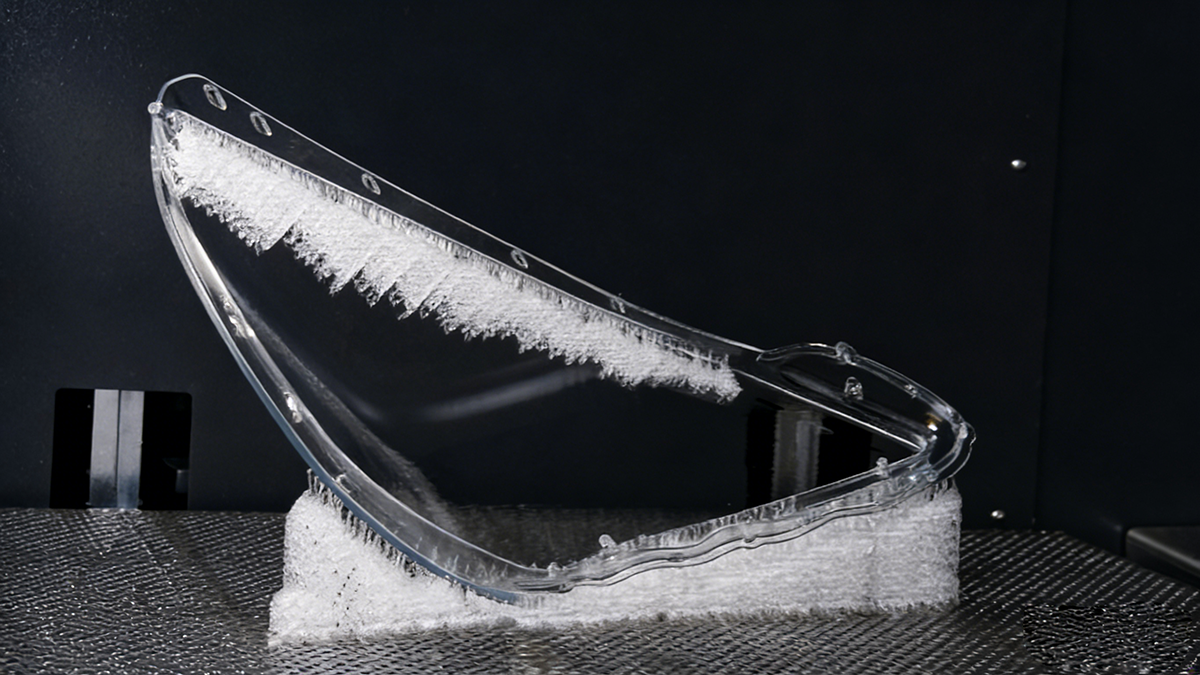
Although the first version of the lamp shade met optical requirements, the client requested additional internal ribs to improve drop resistance during the integration testing. With traditional molds, this would mean another round of mold revisions and at least a week of delays.
However, Mr. Chen completed the rib design modification in CAD that afternoon and reprinted 10 sets of modified samples, which were then shipped to the client for confirmation the next day. The new design not only improved strength but also reduced resin consumption by 22% and printing time by 18% by optimizing print orientation and support strategies.
Learn More
"Time was the biggest benefit we gained. Traditional methods would have taken three weeks, but we delivered the first batch of transparent samples in less than a week and could quickly respond to any design changes."— Mr. Chen
Through this project, Mr. Chen’s team has incorporated Precision Clear into their standard toolset. In addition to lamp shades and light guides, they have used it to print liquid flow visualization test parts, outer casings for art exhibits, and transparent fitting models for eyeglass nose pads.
"In the past, clients often complained that 3D printed transparent parts were not clear enough or contained bubbles. Now, when they receive samples made with Precision Clear, they have to get very close to the sample to see the print layers. We've even used it internally to produce small batches of lens components—200 pieces per batch, with fully compliant optical performance."
According to Mr. Chen, their next step is to use Precision Clear with larger 355nm SLA printers to produce automotive interior ambient light guide strips and large transparent exhibits. "This material has a very low viscosity, is easy to clean, and has stable color consistency between batches, with no yellowing impurities. For those of us doing optical testing, it’s truly a blessing."

